As of this post, our quick search of Sun Prairie foreclosures shows 25 bank-owned condos for sale in Sun Prairie - all of them listed for less than $200,000.
Now our quick search tools on the property search menu at DaneCountyMarket.com make it easy to find bank-owned and short sale properties in 13 different Dane County communities.
Have a good weekend,
Dan Miller, Realtor, Certified Distressed Property Expert, Keller Williams Realty and DaneCountyMarket.com
Friday, January 29, 2010
25 bank-owned condos in Sun Prairie
Wednesday, January 27, 2010
Quick search for bank-owned and short sale properties now at DaneCountyMarket.com
You can create your own custom foreclosure search at DaneCountyMarket.com.
And now you can run foreclosure quick searches by city for single family home, condo and multifamily real estate. The searches cover both bank-owned and short sale properties.
For example, the city of Madison has 6 different foreclosure quick searches:
So far our foreclosure quick search includes the cities of Madison, Cottage Grove, DeForest, Fitchburg, McFarland, Middleton and Monona. Soon we'll be adding quick searches for Mount Horeb, Oregon, Stoughton, Sun Prairie, Verona and Waunakee.
You'll find our foreclosure quick search on the property search menu at DaneCountyMarket.com.
Dan Miller, Realtor, Certified Distressed Property Expert, Keller Williams Realty and DaneCountyMarket.com
Saturday, November 28, 2009
How some investors are using their cash
We recently wrote about 4 brothers who are using their cash to invest in multifamily real estate - a long term approach to real estate investing. Other investors are using their cash in a different way.
We're working with one local investor group that has amassed a large sum of money for short-term real estate investment. The investor group uses its cash to buy distressed properties, which are then rehabbed and sold for a profit. Because this group pays cash for its investments, it can close on a property in a matter of a few days once an offer is accepted. This makes this buyer a good fit for the distressed property owner who needs to unload a property quickly - and without any worry of the deal falling apart due to a financing or inspection contingency.
We're also talking to an out of state investor group about its goals. This group has successfully implemented an investing system in several different markets around the country. In each market, the group uses its cash to buy 3 to 10 properties a month. Similar to above, these properties are rehabbed and then sold for a profit.
The advantage of the buy, fix and flip approach mentioned above is the investor receives a return on his investment in a matter of just a few months. In fact the investor can re-invest his money several times throughout the year for a very nice profit.
The disadvantage is there is more risk. These investors mitigate their risk by having clear standards. They focus on starter homes, where there is a relatively strong demand for the supply that is on the market. They "buy right" (ie at a good price), which gives them some cushion in case something unexpected pops up during the rehab process. They also develop detailed and realistic plans around the acquisition, rehab and resale of their investments, so they can reasonably estimate their returns.
We expect to see more and more short-term investors due to the growing number of foreclosures in Dane County. Even when foreclosures start to subside, distressed properties will continue to play a large role in the market for years to come. Keep in mind foreclosure levels right now are several times higher than they were just a few years ago. Also, it typically takes 6 to 18 months for a foreclosed home to work its way onto the open market. The irony is the number of distressed properties will continue to increase even as the number of foreclosure filings begins to subside.
Dan Miller, Realtor, Certified Distressed Property Expert, Keller Williams Realty and DaneCountyMarket.com
Thursday, November 19, 2009
Dane County distressed property sales on the rise
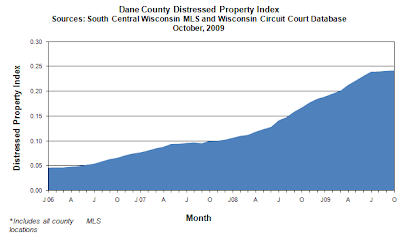
The Dane County Distressed Property Index rose slightly in October to .24, indicating approximately 24% of the home and condos sales in October were related to foreclosure. The chart below shows the index has quadrupled since January of 2006.
On a related note, the Mortgage Bankers Association announced today in its National Delinquency Survey that 14.41% of all loans were either in foreclosure or at least one payment past due at the end of the third quarter 2009. That's a new record.
With a rising number of distressed properties and lower prices, we're seeing a lot of interest from buyers who might not otherwise be in the market. This includes home shoppers, and investors, too. In the last several months we've met multiple buyers who have been saving their cash for the right moment to jump in. And many of them are jumping in right now.
Soon we'll share some stories of different buyers and how they are leveraging the market.
Have a good Friday,
Dan Miller, Realtor, Certified Distressed Property Expert, Keller Williams Realty and DaneCountyMarket.com
Wednesday, October 21, 2009
Do you know someone who is worried about foreclosure?
This web site - DaneCountyShortSales.com - has a list of useful resources. It also includes basic information about the short sale process, as well as information on how we've structured our real estate team to assist our short sale clients.
You won't find any heavy spin on the site. We've done our best to lay out the information in a concise and straight forward matter. Also, we don't force users of our site to give up their contact info in order to view our information.
Have a good day,
Dan Miller, Realtor, Certified Distressed Property Expert, Keller Williams Realty and DaneCountyMarket.com
Monday, October 19, 2009
Plenty of buying opportunities on the horizon in Dane County
Approximately 24% of the home and condo sales in Dane County are related to foreclosure. This is according to a new measure - the distressed property index - that we've developed along with Peter Zarov from Homestead Title. The graph below shows how the index has grown by almost 5 times since January of 2006.

Thursday, October 1, 2009
How we assist our short sale clients
Our real estate team is assembling a group of short sale experts to assist our clients who need to sell before the lender takes possession. Our goal is to involve the right experts at the right time to ensure our clients get their homes sold.
First, we have a team of three Realtors who have achieved Certified Distressed Property Expert designation. The three of us work together to effectively price and market our listings. We also ensure our clients have the right paperwork in place for the proposal packet that is submitted to the lender.
Second, we have enlisted the services of short sale facilitators who assist in submitting the short sale packet and work with the lender once the packet has been submitted. Our short sale facilitators come from Homestead Title. The Homestead Title team works with the lender to keep the sale moving forward. If issues arise during the approval process, our facilitators work to get them addressed quickly. And, Homestead Title will ensure that there are no 11th hour surprises and that all lien holders are identified early in the process.
Third, we provide our short sale clients with the services of an attorney of their choice. The attorney's job is to protect our client's best interests as we facilitate the sale with the lender.
Soon we'll be launching a web site designed for people who are in danger of losing their home to foreclosure. More on that coming soon.
Dan Miller, Realtor, Certified Distressed Property Expert, Keller Williams Realty and DaneCountyMarket.com
Wednesday, September 30, 2009
Dane County foreclosure filings reach a new high in September
Although the month of September is not in the books yet, foreclosure filings in Dane County will reach a new high this month. Keep in mind that most foreclosure filings result in either a short sale or a sheriff's sale, many of which do not occur until 6 to 18 months after the filing. Expect distressed property sales to become a large and growing part of the real estate market over the coming year.
Dan Miller, Realtor, Certified Distressed Property Expert, Keller Williams Realty and DaneCountyMarket.com
Monday, September 28, 2009
Short sale failure: some reasons why
Short sales have been in the news a lot lately, and by now we've all read and heard stories about many short sales failing. Here are some reasons why many short sales do not succeed:
Improper pricing. First and foremost, a short sale needs a willing buyer and an accepted offer. A short sale property needs to be priced to sell, without giving away the farm.
An incomplete or improperly submitted proposal package. Once an offer is accepted, the seller needs to submit a proposal package to the lender for its review. The proposal package includes multiple documents and dozens of pages. If the package is incomplete or improperly submitted, it can delay the approval process and cause the sale to run out of time before the sheriff's sale. An experienced Realtor is essential to avoid these mistakes.
Inadequate follow-up. Once the proposal package is submitted effective communication with the lender is critical. If the listing team is not proactively communicating with the lender and helping to move the short sale through the approval process, delays can occur, causing the seller to run out of time or the buyer to walk away from the transaction.
Failure to negotiate all liens. A successful short sale requires that all debts that are liens against the property are satisfied. This requires the agreement of each and every creditor/lien holder and usually requires at least partial payment of the debt. Failure to identify which liens to negotiate can derail a short sale at the 11th hour.
Thanks to Peter Zarov from Homestead Title for his contributions to this post.
In a future post we'll share how our real estate team is addressing the pitfalls listed above.
Dan Miller, Realtor, Certified Distressed Property Expert, Keller Williams Realty and DaneCountyMarket.com
Sunday, September 20, 2009
Why lenders will accept a short sale
Lenders are in the business of finance, not real estate. They're not designed to own a portfolio of properties. There are many good reasons why a bank will accept a short sale over foreclosure. Here are just a few:
Legal fees. Foreclosure requires attorney fees that can be avoided through a short sale.
The declining market. In a declining market, a property loses value for every month it does not sell. A short sale allows a property to be sold more quickly and at a higher market value.
Holding costs. Holding costs for lender-owned properties add up quickly. These costs include taxes, insurance, utilities, maintenance, management, and other costs.
Repairs. In some cases lenders end up owning properties that are in need of significant maintenance and repair. Some owners who are losing their home to foreclosure neglect or intentionally damage their home.
There are many good reasons for lenders to choose a short sale over foreclosure. Despite these reasons, many short sales are not successful and end with the lender owning the property. We'll cover some reasons why in a future post.
Dan Miller, Realtor, Certified Distressed Property Expert, Keller Williams Realty and DaneCountyMarket.com
Wednesday, September 9, 2009
Resources for home owners facing foreclosure
Many people who lose their home to foreclosure do so without knowing and reviewing other alternatives. If you are at risk of losing your home, here are some things you can do to learn more about your options:
First and foremost, talk to your lender. You and your lender may be able to work out an alternative to foreclosure.
Educate yourself. The Dane County Housing Authority provides some useful online materials, including:
- How to avoid foreclosure on your home
- The foreclosure timeline in Wisconsin
- Responding to a foreclosure lawsuit
Talk to an attorney. The Lawyer Referral and Information Service (608/257-4666) can put you in touch with an attorney who handles cases like yours.
Consult with a Realtor who specializes in short sales. Your Realtor can help you determine whether or not your home will qualify for a short sale. If it does qualify, he'll outline a plan that will help to get your home sold prior to the sheriff's auction.
Have a good day,
Dan Miller, Realtor, Certified Distressed Property Expert, Keller Williams Realty and DaneCountyMarket.com
Thursday, September 3, 2009
Reasons for choosing a short sale over foreclosure
For many home owners the short sale is the preferred solution over the foreclosure. Here are some reasons why:
(A quick note before we proceed with the list below: Our real estate team recommends you pursue all of your options, including working proactively with your lender, to discuss solutions other than a short sale or foreclosure. If you do pursue a short sale we highly recommend you work with an attorney who will work to protect your best interests and work to minimize a short sale's impact on your credit score. Our real estate team includes the services of an attorney for our short sale clients.)
Future Fannie Mae loan for a primary residence
Foreclosure: A home owner who loses a home to foreclosure is ineligible for a Fannie Mae-backed loan for a period of 5 years.
Short sale: A seller who successfully negotiates and closes a short sale will be eligible for a Fannie Mae-backed mortgage after only 2 years.
Credit score
Foreclosure: Credit score may be lowered by 250, 300, or more points. Credit will typically be affected for 3 or more years.
Short sale: Late mortgage payments are recorded, which does negatively impact credit score. After the sale the mortgage is reported as "paid in full", "paid as agreed", "paid as negotiated", etc. A short sale typically decreases a credit score by a lesser amount than a foreclosure, and credit can be repaired in as little as 12 to 18 months. As we mention in the note above, we recommend you use the services of an attorney during the short sales process, so you a have a qualified legal expert who is protecting your interests and working to minimize the impact of the short sale on your credit score.
Credit history
Foreclosure: Will remain on a person's credit history for 10 or more years.
Short sale: A short sale is not reported on a person's credit history. There is no explicit recording item for a short sale.
Future employment
Foreclosure: Many employers are requiring credit checks on all job applicants. A foreclosure is one of the most detrimental credit items an applicant can have, and in many cases will challenge employment.
Short sale: A short sale is not reported on a credit report and is therefore not a challenge to employment.
Current employment
Foreclosure: Employers have the right and are actively checking the credit of employees who are in sensitive positions. In some cases, foreclosure is reason for reassignment or termination.
Short sale: A short sale is not reported on a credit report and is therefore not a challenge to employment.
Security clearance
Foreclosure: Foreclosure is the most challenging issue against a security clearance outside a serious misdemeanor or felony conviction. If a client has a foreclosure and is a police officer, in the military, in the CIA, or in any other position that requires a security clearance, in many cases clearance will be revoked and the position will be terminated.
Short sale: On its own, a short sale does not challenge most security clearances.
Deficiency judgment
Foreclosure: In 100% of foreclosure cases (except in those states where no deficiency is recorded), the bank has the right to pursue a deficiency judgment.
Short sale: In some successful short sales, it is possible to negotiate with the lender to give up the right to pursue a deficiency judgment against the home owner. We recommend you use the services of an attorney when it comes to negotiate the recording of the deficiency.
Deficiency judgment (amount)
Foreclosure: In a foreclosure, the property will end up being owned by the lender if it does not sell at auction. In most cases this will result in a lower sales price and longer time to sale in a declining market. This will result in a higher possible deficiency judgment.
Short sale: In a well-managed short sale, the home is sold at a price that is close to market value. In almost all cases the short sale price will be higher than an REO price, resulting in a lower deficiency.
This information comes courtesy of the Distressed Property Institute. We'll continue to cover the short sale market in more detail over the next few weeks.
Have a good day,
Dan Miller, Realtor, Certified Distressed Property Expert, Keller Williams Realty and DaneCountyMarket.com
Sunday, August 30, 2009
Short sales: qualifying reasons for financial hardship
In our last post we defined a short sale. In order to qualify for a short sale, a home owner must be able to demonstrate one or more of the following:
- financial hardship,
- negative cash flow, where monthly expenses exceed monthly income, or
- evidence of pending loss and insolvency
The most common justification for a short sale is financial hardship.
And by far and away the number one reason used to justify financial hardship is a mortgage adjustment or loan payment increase.
Other qualifying hardhip reasons include the following:
- Separation or divorce
- Job loss
- Reduced income
- Excessive debt
- Death of a spouse or family member
- Severe illness
- Involuntary job relocation
- Business failure (for the small business owner)
- Damage to property
- Inheritance (for heirs receiving ownership of property)
- Military service
- Tax or insurance increase
- Incarceration
When you sell your home as a short sale, one of the things you will need to do is write a hardship letter to your lender. We recommend you keep the letter to a single page.
We'll cover this and other aspects of the short sale process in the near future.
Have a good day,
Dan Miller, Realtor, Certified Distressed Property Expert, Keller Williams Realty and DaneCountyMarket.com
Saturday, August 29, 2009
What is a short sale?
An owner "is short" on his property when the amount he owes on his mortgage, combined with commission and closing costs, is higher than the current market value of the property.
A "short sale" occurs when a negotiation is entered into with the property owner's mortgage company (or companies) to accept less than the full balance of the loan(s) at closing.
A short sale is the preferred solution for many home owners facing foreclosure. That's because among other things a foreclosure can have a large and lasting impact on a person's credit score, credit history, and job status. More on this topic will be coming soon.
In order to qualify for a short sale, a home owner must be able to demonstrate one or more of the following:
- financial hardship
- negative cash flow where monthly expenses exceed monthly income, or
- evidence of pending loss and insolvency
The most common justification for a short sale is an increase in monthly mortgage payments. We'll cover this and other acceptable forms of financial hardship in our next post.
Dan Miller, Keller Williams Realty and DaneCountyMarket.com
